Sunday, December 11, 2011

LISTMANIA 2011--NO REGRETS!: Music

The ranked list, I'm afraid, is a dying art. As a culture, we're tending toward cluster, towards a society of "in no particular order", but, to me at least, there's a wonderful sense of questing involved in The Best Of List. In attempt to rank art, you wind up really engaging it, and asking yourself some pretty deep questions. What makes one work better than another? How do you compare to wildly varied creations? What does that number one spot really represent? What is "best"? Some find this a headache. I find it not just fun, but weirdly soothing, sort of the intellectual equivalent of therapeutic dorm-room cleaning--there's a luxurious comfort to be found in putting things in their right place. And so, as usual, I'll be sorting through my experience of the past year and attaching said experiences to numbers--the best this, the worst that, and so on. And, as usual, I'll be splitting these lists into four categories: Music, Books, Movies, and, finally, Moments. Seeing as every major album to be released in 2011 has already hit shelves, from Gaga's latest effort to Bieber's latest tragedy, I think I'll start off with Music.

---

The Music of 2011: The Best, The Worst, And A Little Too Much Adele

I'll begin with the same disclaimer I issued last year: I'm time signature master. I'm no LP collector. I'm no Cameron Crowe. My theoretical knowledge of music consists of exactly as much breadth and depth as Rick Perry's theoretical knowledge of rational Christianity (that's my one cheap shot, I promise.) Then again, I kind of relish this lack of understanding; I can ignore the technicalities of this tonic or that rhyme scheme and just let music, in all its glory and delirium, take me places. I think everyone needs an art like that; one that they don't read or write or theorize about, one that just happens to them. So, I'm evaluating these albums the same way a hippie would evaluates their drugs; by asking where they took them and what it was like. This year, great trips were plentiful; this was one of the best single years for mainstream music in recent memory, a year in which artist after artist released great album after great album, unleashing a steady river of musical gold the likes of which will be discussed for years to come. It was the year that some of our greatest musicians decided that, having finally accrued enough mainstream acclaim and critical praise, they were free to experiment a little. Some of these experiments crackled and fizzled in equal doses, (Mylo Xyloto, Born This Way), while others went up in flames. (well, Radiohead had to take a tumble sometime). This list represents the best of those experiments; the ones that blended old and new to create something beautiful and lasting. All of them changed the scene in some way, big or small; some of them changed my life. Let's take a look, shall we?

THE BEST:

Runner Up:
Revelation Road, Shelby Lynne


If Taylor Swift represents the guilty pleasure glee of country twang swelled to ballpark proportions, Shelby Lynne is the reigning champion of a more intimate country, the kind of music created by someone with nothing more than an old guitar and a little conviction. Her work exudes a simple, almost sensual subtlety; songs like "I'll Hold Your Hand" and "Toss It All Aside" address the Old Country Tropes of love, commitment and faith without sinking into goopy sentimentality. Possessed with a keen songwriter's mind and a voice like bitter honey, Lynne has made an album that goes down sweet and easy in this age of the Hard Sell.

10. Nothing Is Wrong, Dawes

Not for nothing does Jackson Browne guest on one of these tracks; Dawes's sophomore album is a delightful piece of alchemy, an eleven-track sprint through the mysteries of love and loss that's anchored by its effortless integration of indie experimentation and the unpretentious lyricism of Browne's own Goffin-King 70's era. Songs like "Coming Back to A Man" wouldn't have been possible without the singer-songwriters of yesterday, but they also wouldn't be half as memorable if they didn't tip their hat to the musical eclecticism of tomorrow. This band dominated the Blogosphere this year, and rightfully so.

9. What Matters Most, Barbra Streisand

WTF, Mason? You gave this one a pretty good licking upon its initial release. Yes, I did, but, shocker, the thing has grown on me--my first listen was irreparably tarnished by the fact that this album wasn't anything like her last one, Love Is the Answer. But then again, it wasn't supposed to be; if that record was a showcase of Streisand's jazzy finesse, her ability to collaborate with her fellow musicians, this one has the orchestra working for her, not with her--they're simply creating an non-intrusive backdrop that allows Streisand to explore the lyrics of her favorite writers, the Bergmans. And explore she does; in terms of vocal ingenuity, she's never been better. The way she bends the phrase "countless days" into a crescent moon of longing on "So Many Stars", her effortless segue from conversational speak-song to full-throttle belting on "I'll Never Say Goodbye"--these are how-to lessons in interpretation and performance. For the record, though, I still hate the Kenny G sax on "Solitary Moon". Just sayin'.

8. The Book of Mormon, Original Broadway Cast
If Spring Awakening was an all-time game changer, then The Book of Mormon is a welcome, one-time anomaly--you won't ever hear anything like it again. Blessed with an crackpot cast and a deliciously witty libretto by Trey Parker, Matt Stone, and Robert Lopez, the show toes the line of good taste while still thrumming with an unabashed sweetness and jazz-hand pizzazz. Songs like "Man Up", "I Believe", and the album highlight "Tomorrow Is A Latter Day" offend and inspire all at once. This isn't just an album; it's a document of a Broadway miracle.

7. Barton Hollow, The Civil Wars


Not since At Folsom Prison has a country-tinged record given off such a distinctively individualistic badass vibe. You have to listen to "Girl with the Red Balloon" and the title track a couple times before you get ahold of their distinctive genius, the way they burst boundaries without showing off; this is country music that isn't afraid to be wounded, confused, or just plain pissed off. In a word, it's raw. Plus, this duo's got the best harmonies this side of Fleet Foxes. God bless them for giving folk its balls back.


6. Camp, Childish Gambino
Community star turned down n' dirty hip-hop artist Donald Glover isn't everyone's cup of tea. His flow is less musical than, say 'Ye or Lil Wayne; he grunts, chuckles, whispers, and moans through these songs like they're monologues, not pieces of music, often forsaking rhythm and rhyme just to get his point across. Still, those up for something different will find a true treasure; a rap album that's actually a scathing critique of industrialized rap itself. "Is there room for a lame who rhymes/Who wears short shorts and makes joke sometimes?", he asks on the contagiously NSFW "All the Shine". Based on this album, I'd say yes.

5. Helplessness Blues, Fleet Foxes


Look, I loved "White Winter Hymnal" as much as the next guy, but to me, Fleet Foxes' debut album was like an artifact; beautiful, but a bit removed from the here and now. Their follow-up fixes this problem from the get-go; tracks like "Sim Sala Bim", "Battery Kinzie" and the instantly memorable title track ditch any traces of dainty pastoralism and use the bands earthy ingenuity as a sturdy engine to power expeditions into disillusionment, confusion, and regret. By the time you reach the end of the album's by-far best track, "The Shrine/An Argument", you're left with a distinct sense of a band shedding its skin and acquiring a tougher, better, more beautiful one in the process.

4. Sky Full of Holes, Fountains of Wayne
If Fleet Foxes deserve praise for evolving, Fountains of Wayne earns its hosannas for staying exactly the same--for crafting straightforward, cheeky odes to the common man without stooping to hipsterish irony. "She's been afraid of the Cuisanart since 1977", the album starts, and it only gains traction from there. The band's only gotten better since the "Mexican Wine" days--"Richie and Ruben" and "A Road Song" are perfectly compressed gems of alt-pop that get you high on their buoyant simplicity while exuding a deft, celebratory, almost Springsteenian lyricism. After all these years, they've still got it going on.

3. So Beautiful or So What, Paul Simon


Paul Simon's never really had a career slump. Then again, I should also note he's never really matched the angelic heights of Graceland, my all-time favorite album. This one doesn't reach the rarefied atmosphere of that record, but it's by far his best since The Rhythm of the Saints twenty years ago. If his early albums were full of youthful exuberance and his more recent explored the conundrums of middle age, this one finds Simon facing the specter of death as only he can--with rational optimism, musical ingenuity, and an unshakeable sense of humor. Whether portraying Heaven as an inefficiently run office building ("The Afterlife") or delivering a rambling monologue as the voice of God ("Love Is Eternal Sacred Light"), Simon astounds with his daring. The title track is everything great about Paul compressed into four minutes. Starting with a man making dinner in his kitchen and ending with a meditation on the MLK assassin, this song is the closest Simon's every come to a career statement. "You know life is what you make of it/So beautiful, or so what", he sings. Thanks to Simon, ingenious songwriter, generous spirit, and, as I now know, brilliant live performer, it's a little easier to vouch for the "so beautiful" option.

Brief interlude: All my life, I've wanted Those Albums. You know, the ones your parents keep at the top of the shelf, the ones your uncle is constantly hauling out at parties to play for anyone who will listen. The albums that aren't just great, but are definitive--you identify so intensely with what they say and how they say it that they become inextricably associated with a time in your life, a time you can easily recall whenever you press "play". These same albums also give you courage for the future. This year, miraculously, a bunch of these albums came to me all at once. The remaining albums aren't just the best of the year; they're some of the most meaningful musical projects I've ever encountered.

2. The King Is Dead, The Decemberists

"Here we come to a turning of the season", Colin Meloy sings on the opener "Don't Carry It All", and he's not kidding. The Decemberists have done great stuff before--"A Song for Myla Goldberg" and "O Valencia!" are already monolithic classics in my mind--but they've never put out an album as full-blooded, as fundamentally alive as this one. It's more accessible than their early stuff, yes, but that's not what makes it great. There's something in between the songs here, something ineffable, that grabs you and pulls you into a wonderful new world, at least for a little while. Whatever this something is, it's lent the band a stunning surge of focus--these songs are lean and direct without surrendering any of the band's trademark philosophical weightiness. It's sent them expanding in new directions--the ramshackle rave-up of "Down by the Water", the propulsive hooks of "Calamity Song". Perhaps most importantly, this something has found its way into Meloy's voice, a voice that was already damn close to being the greatest in all of folk-rock. When he addresses his real-life son on "Rise to Me" or reflects on a dying landscape on "June Hymn", his nasal wail is full of a newly tapped warmth and intimacy; his instrument is so beautiful that it's almost painful. This is the kind of album that moves you to tears, not because the music is inherently sad, but because such rare birdies just don't come along very often. It's impossible to listen and feel anything but awe.

AND THE HUGELY SURPRISING NUMBER 1 IS....


1. 21, Adele/Ceremonials, Florence + The Machine


What? A tie? You sellout! Calm down, raging masses, for, like all overly defensive liberal arts nerds, I have my reasons. Firstly, I honestly believe that these two albums are comparable in quality--how could I possibly choose between "Rolling in the Deep" and "Shake It Out"? "Rumour Has It" or "Lover to Lover"? Yeah. That's what I thought. Secondly, and most importantly, these albums signify the apex of the greatest musical trend of the 00s: The Diva Revival. No granola-y singer-songwriters, no gauche hair bands or synth collectives, and certainly no grunge groups--this has been the millennium of the empowered woman, standing alone on the stage and giving it all she's got. Not since the days of Ella, Sarah, and Dina has the solo female artist dominated the pop scene with such totality, and for good reason; a set of obscenely talented women have stepped up to the mic in recent years. Xtina's down n' dirty riffing, Gaga's sultry purr, Amy's already-missed contralto wail--these girls have voices that rank with the greatest of all time. So do these two ladies, who with their pair of sophomore albums prove themselves musically courageous artists with towering ambitions and a surplus of talent with which to bring them to life. Before anything else, there are Those Voices, with a capital T and and capital V. Florence's is shot through with a strange, otherworldly beauty--her tense, utulating belt sounds like something from two hundred years in the future; it's got all of Bjork's ethereal resonance but none of her removed, pixieish dissonance. Adele, on the other hand, is firmly rooted in nostalgia, following in the glorious footsteps of the Old Greats-Springfield and Joplin, with a little bit of Bette Midler and Dolly Parton thrown in for good measure. As with all classic songs, the tracks on these albums are perfectly suited for the thrillingly idiosyncratic talents of the respective singers. "Don't You Remember" could come off as sappy pseudo-country, but Adele leans into the refrain ("The reason you loved me...") with enough raspy, palpable anguish to make the song as true as life itself. Any other artist would come off as kill-me-now awkward singing a break-up song laced with haunted-house imagery; Florence attacks "Seven Devils" with so much authority that it hits you like a shot. Rihanna could learn a lesson or two from these girls.

That makes these albums great. But we have yet to address what makes them classics, A-grade achievements that will be treasures of diva-dom like Dusty in Memphis, At Last! and I Never Loved A Man The Way I Love You before them. What will render these albums eternal, I think, is the way that they announce to the world two Full-Blown Artists. These albums present to us two singers who have in their 20s a complexity and honesty that many a modern pop artist will never begin to touch. "Dog Days Are Over" was a beguiling slice of indie-rock catchiness, yes, but who would've thought that the woman who wrote it could also pen a radio-friendly pop-gospel paean to Virginia Woolf's suicide ("What The Water Gave Me")? More to the point, could anyone have guessed that the "Chasing Pavements" singer had locked away somewhere inside that head of hers a titanic knockout of a ballad which would become the greatest break-up song since "Yesterday"? Even those of us who kept Lungs in our car for months at a time could've never anticipated a Florence song as thrillingly intricate and viscerally gorgeous as "All This and Heaven Too". And none of us who chilled out to the jazz-tinged simplicity of 19 were prepared for the gut-wrenching catharsis of "Set Fire to The Rain". These two albums, both alive to the sound of heartbreak yet alert to the possibility of healing, are shining examples of mainstream music done right. Most importantly of all, these sophomore releases prove that Florence and Adele have not just talent and vision, but that other quality of all great artists--the ability to surprise us. If their first albums said "I'm here", these say "I'm here to stay."


Wednesday, December 7, 2011

To Governor Perry

Dear Mr. Perry,

I'd like to commend you on your new ad. I know it's been a rough couple of weeks, what with your little debate kerfuffle (let bygones be bygones) and messy, messy Herman Cain business (what a rascal, huh?!), so I figured you could use a sincere compliment or two.

First of all, excellent choice of location. The plunging greens and the soft autumnal hues lent some moment to the proceedings; instead of addressing us from inside city hall or behind an office desk, you bravely stationed yourself out in the wilderness, in the dirty, oakish, primeval thick of it. It's clear that you, sir, are a truly Emersonian man of nature, one who devotes great amounts of time to deep thinking in the shadows of tall trees. In fact, at the beginning of the ad, it appears as if you are walking away from such a meditative session. You're a true man of the outdoors, and I of all people appreciate it. This location is so gorgeous that I almost considered looking it up, but as you and I both know, research is overrated.


Secondly, give that cameraman a raise!! The entire ad is clearly shot and in focus. You've got the best people working for you.

Finally, I must say that I admire your conviction. In the theater of politics, there's something about the subject's eyes--if you look closely, you can often see a thought shaking in its proverbial boots, ready to rush out the revolving door whenever it isn't popular. If you look really hard, sometimes you can even catch a glimpse of the brand new thought rushing into take its place. But not you, sir. I look at you and I see a certain solidity--you have beliefs, and you'll stand by them. You have a backbone, something only approximately 2.6777% of all living politicians have. However, one small caveat; I'm having a great deal of difficulty locating your brain.

What do I mean? Well, let's take a look at a transcript of this ad, shall we?

"
I'm not ashamed to admit that I'm a Christian, but you don't need to be in the pew every Sunday to know there's something wrong in this country when gays can serve openly in the military but our kids can't openly celebrate Christmas or pray in school.

As President, I'll end Obama's war on religion. And I'll fight against liberal attacks on our religious heritage.
Faith made America strong. It can make her strong again.
I'm Rick Perry and I approve this message."

Ok, so just a couple things:

1) Of course you aren't ashamed to admit you're a Christian. You shouldn't be. We've all faced persecution for our beliefs, and we ought not have to sit uncomfortably in the cocoon of our own convictions. You were most likely attracted to Christianity from a very young age. It called to you, and you followed it, because, well, you couldn't not follow it. Your thought process probably went something like this:

1) If I find something meaningful, and it do not expect it to harm others, I will pursue it.

2) This will not harm others.

3) Therefore, I will pursue it.

I appreciate this message, this call to be one's self. The problem is, you abandon it midway through the sentence. After all, by expressing discontent with homosexuals serving in the military, you're implicitly displaying disdain for homosexuality in general. It's not just that you don't support gay rights; it's that you damn them using the same argument with which you praise your own Christianity. I'm confused as to how, from the above three step process, you deduce that you have a right to the pursuit of happiness, and gays do not. I suppose you could claim that accepting gays into our mainstream culture would be harmful, either to our national moral fabric or the institution of marriage. But as far as I know, no national standard of morality exists; we are free to hold our own ethical beliefs, assuming they don't cause some sort of kink in the clockwork, don't actively interfere with our country's day-to-day safety. In terms of the marriage objection, all I can say is this; Dictionary.com defines marriage as such:

a.
the social institution under which a man and woman establish their decision to live as husband and wife by legal commitments, religious ceremonies, etc. separation.
b.
a similar institution involving partners of the same gender: gay marriage.

Firstly, I must ask; how does it feel to hold opinions that are so philistine even the dictionary no longer recognizes them? Unless of course, you have a different understanding of marriage; if you define marriage as a process by which two persons of the opposite sex become vessels with which to produce little, drooling voters-to-be, I suppose homosexuality is very wrong. But if marriage is indeed nothing more than an official establishment of commitment--the dictionary definition--I don't see how gender comes into at all. But I've gone off on a tangent. Let's skip ahead to my favorite part:

2) "As President, I'll end Obama's war on religion." Firstly, when last I checked, Barack Obama won the last election, fair and square. Love him or hate him, but even if you think its a monster, call the monster by its proper name--President. But anyway, here's my problem. Take a look at the way you use the word "war" here. You aren't talking real guns n' ammo war, but a metaphorical battle. That's fine. However, earlier in the ad, you bring up the military, and condemn the repealing of the "Don't Ask, Don't Tell" law. This shows a serious concern for our armed forces--it appears you really do care about who they are and what they're doing. But then, you use the word "war" in reference to a conflict that is not only non-violent in nature, but almost entirely imagined. If you're trying to convince me that President Obama is waging a "war" on religion, you must provide concrete examples. Just because you say it doesn't make it so. Many of your followers don't get that. I do. To use a word that carries with it true electric power, that throbs with the ache of loss and trauma and rumbles with the godless threat of gunpowder and shattered shrapnel and death itself and then apply that word to a petty conflict of compromised values is offensive. To use that word mere seconds after expressing concern for our armed forces, who are in the midst of a real war, is about the most unpatriotic thing I can think of.

3) "
Faith made America strong. It can make her strong again." This is a really funny joke. You should tell it at parties. Faith did not make America strong. Logic made America strong. A group comprised of atheists, agnostics, and true believers, united by a willingness to compromise and a knack for thinking clearly and creatively--these people made America strong. I would remind you that our last attempt to govern based on religious thought alone gave us the Salem Witch Trials. I don't know what America you love, Mr. Perry, but I love the America That Reasons; the America that feels the weight of false traditions and uses the power of idea and rhetoric and mastery of the mind to lift that weight. I don't love the America That Worships False Idols, that spends its time making gaudy Golden Calves out of old Americas that never existed; a Christian America, a Conservative America and, God help us, a Simpler America. The America you want to "re-create" has never been created at all, and for a good reason; we're better than that. I don't see a single concrete example in your entire ad. I see the words "something wrong", but I don't see a single word about WHY it's wrong. I guess we're supposed to assume that you just know its wrong, because just knowing is what got the Constitution signed, isn't it? There are those who would call you a tyrant, who claim that your presidency would usher in a Stalinesque repression of free speech. I think that's a tad ridiculous. We wouldn't be a country run on oppression. However, we would be a country run on unfounded beliefs and unchecked nostalgia. And that's damn near as dangerous.

4) "I'm Rick Perry, and I approve this message." I can't refute this statement. I wish to God I could.

Please reconsider a few things, Mr. Perry; first your run, then your beliefs. Think about them, not in terms of abstracts, but in terms of concrete logic--maybe for the first time.

I'll be back next week with the first edition of my annual Best-Of-Listomania. Maybe by then, my blood pressure will have cooled.

Sunday, November 20, 2011

The Contrarian Critic: Strange Opinions on Two Oscar Heavyweights

The Descendants

For almost a decade now, a Great Cinematic Question has plagued me, fermented endlessly in the wine cellars of my mind--why oh why does everyone love Sideways so damn much? Yes, the picture had a reasonably clever screenplay, some gorgeous location photography, and a real live-wire in Paul Giamatti's maladjusted wine snob Miles, but Alexander Payne's road-trip picture wasn't just praised--it was enshrined, hoisted up like a trophy by critics and audiences alike and placed on a pedestal beside that ultimate achievement in contemporary dramedy, Annie Hall. Perhaps it was our hunger for movies like Hall that cued the Hallelujah chorus; maybe we were so desperate for a motion picture that treated us like smart, discerning adults that to us a well-prepared appetizer tasted like a five-course feast. And so it goes with Payne's latest offering The Descendants. Once again, I left the theater reasonably satisfied, and once again, it seems that everyone else left the theater in a state of religious ecstasy that'd make the Pope blush. It's not a bad picture, but the absence of mediocrity does not indicate the presence of greatness.


George Clooney stars as Matt, a Hawaiian businessman with a comatose wife and a pair of rumpus-raising daughters, Alexandra and Scottie (Shailene Woodley, Amanda Miller). Matt knows his wife Elizabeth (Patricia Hastie) isn't long for this world, but what he doesn't know is this; the past few years, she'd been conducted an on-again-off-again affair with a hotshot realtor (Matthew Lillard) and was working up the courage to ask for a divorce. Ever the chivalrous alpha male, Matt sets out to sets out on a road trip, dragging his kids and Alexandra's boyfriend Sid (Nick Krause) across the coast in attempt to track down the Other Man and give him both the bad news and a piece of his mind. Lovesick dope on a long, winding road-trip--sound familiar? It should--at the most skeletal storytelling level, this picture follows the blueprints of Payne's previous two pictures, About Schmidt and The Overrated-Flick-Which-Must-Not-Be-Named. And once again, Payne does a great deal right. If nothing else, he is a masterful assessor of local color--wherever his movies are set, we feel that setting in our bones. His Hawaii is a state furiously and fascinatingly divided, struggling to reconcile the mythical power of its history with the chintzy palm-tree reality of its present. It's a struggle between what once was and what now incontrovertibly is, as is Matt's search for his wife's lover. It's a search rooted in both nostalgia and deep-seated anguish, emotions which Clooney conveys subtly and accurately. He's always had a knack for King-of-The-Road suavity, but in recent years, his craft has deepened; pictures like Up In the Air and Michael Clayton showed a rawer, realer Clooney, a man capable of charming the pants off of anyone, yes, but also a man whose smooth-operator glibness masks a keening moral anger and a mounting list of regrets; a man haunted by the silence of things unsaid and deafened by the noise of lies told, a man whose fury is never obvious but always present. In The Descendants, Clooney's exploration of the Boastful But Broken American Male reaches something of an apotheosis--his work here is resonant, sensitive, and true. The pair of passive-aggressive monologues he hurls at his catatonic wife are the movie's hilarious and heart-breaking highlights, but his looks speak volumes as well; to watch Matt run down the street in flip-flops and a flowery polo after he's hit with the knowledge of his wife's infidelity is to watch a man wrestle with his inner demons and lose. He's a messy, wonderfully complex character; I wish I could say the same for the rest of the ensemble. It's not that the other characters are one dimensional; they're intriguingly multi-dimensional, but never all at once. For example: Alexandra isn't rebellious but kind; she's a nuisance until the script requires her not to be. Sid isn't a jerk with the potential for goodness; he's a stereotypical jerk until some awkwardly imparted information changes our view of him, because the Bad Kid has to turn Good in a movie like this. And then there's Matt's cousin (Beau Bridges) as cartoony a token asshole as I've seen on screen this year. Admittedly, the strength of the cast goes a long way towards nullifying these flaws--Woodley in particular fleshes out her character in ways the script simply refuses to. Still, when you've got a walking grey zone like Matt at the center of a story, it just doesn't do to surround him with black-and-white boilerplates.

It occurs to me that, in this Age of Irony, it probably seems like I'm try to damn the film with faint praise. I'd say what I'm really getting at is praising the thing with faint damning. The Descendants is not a great film, but just because it doesn't deserve a shelf full of statuettes doesn't mean it's not worth your time. The film is never boring, never anything less than totally genuine in it's desire to tell a story well. More often that not, it succeeds. Those who see it will enjoy it. Some will probably love it. The great critic Jonathan Rosenbaum often advises filmgoers to be explorers, not conquistadors, to search for every film's redeeming qualities instead of looking for artistic trophies to claim. Here's a film worth the exploration. However, I will say this; when Oscar comes calling, as I'm sure it will, I'll come complaining. B.

J. Edgar


Oh what a beautiful mess. What a gorgeous, insipid, deeply moving, persistently frustrating holy wreck of a movie. J. Edgar is as good a cinematic portrait of it's title character as we could ever hope for. But it tries to be more. Not content with scraping the sky, the picture, belly glutted with dreams, swings for the moon and misses. But what a miss it is.

To tell J. Edgar Hoover's life story in a linear fashion wouldn't just be wrong, it'd be impossible, an affront to a man whose contradictory nature drew him into the midst of a heated love-hate affair with an entire nation. Clint Eastwood and screenwriter Dustin Lance Black know this and plot their picture accordingly--structurally speaking, the picture is less What's Love Got To Do With It and more La Vie En Rose. Edgar's (Leonard Di Caprio) personal life--his closeted homosexuality, his Oedipal mess of a relationship with his mother (Judi Dench)--was not separate from his work; his torturous insecurities bled over into his business dealings as well, re-shaping both his Bureau of Investigation and American government as a whole. What Lance Black's script does brilliantly is convey just how inextricable Edgar's private pains were from his public actions. As Edgar dictates his autobiography, unleashing a string of seemingly random anecdotes and slowly connecting them, history and memory ricochet off of each other with an almost Faulknerian intensity. As Edgar listens to a purported tape of President Kennedy committing acts of infidelity, he struggles in the dark with his own sexual insecurities, listening with a mix of revulsion and curiosity until he's interrupted by a phone call--Kennedy's been shot. Scenes like these, with the past and present colliding at strange angles and striking sparks, are a dime a dozen in this picture. There's an ingenuity to this approach, and it's one that's revitalized Eastwood's filmmaking. If his recent pictures showed him resting on his laurels, indulging in genre posturing (Gran Torino), hagiographic hokum (Invictus) and spiritual silliness (Hereafter), then J. Edgar presents an Eastwood whose got his balls back, who's willing to dive headfirst into a daring project with that old Dirty Harry glint in his eye. He comes at this story with a lean efficiency and sharp sense of scope; the historical scenes, particularly those involving Hoover's war on Dillinger-era crime, pop with a taste-the-gunpowder immediacy, and he shapes the film's more intimate moments--the scenes with Dench and with Hoover's unrequited love Clyde Tolson (Armie Hammer) with a quiet, solid efficacy that pays emotional dividends. This is his best work since Million Dollar Baby. DiCaprio responds with a performance full of the sort of surpassing intensity and commitment that are quickly becoming his hallmark. Instead of attempting the impossible task of building a waxworks replica of the man--his stentorian tones and statuesque posturing, he does a sort of riff on the Edgar we know, a performance that accurately conveys the enigma that was Hoover while commenting on it as well. The man who once proclaimed himself King of The World is now heir to Throne of the Modern Actor. Hammer's work here is equally heart-wrenching, and Dench's Shakespearean training helps her avoid the all-too-easy-trap of playing the villain. Naomi Watts and Josh Lucas prove strong supporting performers, playing Edgar's secretary and Charles Lindbergh, respectively. Here's a movie with all the right players.

What goes wrong, then? What's the problem with J. Edgar? For most of the movie, there isn't one, unless you count the duo of cut-rate impersonators hired to cameo as Kennedys. That aside, the first hour and a half of J. Edgar is as good as any biopic released in the past couple of years. The trouble comes in the film's final act, when Lance Black and Eastwood ditch the biography and start pushing for iconography. As DiCaprio's Hoover inches closer towards death, face sinking under the weight of some truly awful old-age makeup, the filmmakers start using his misery as a metaphor, sneaking in monologue after monologue, keeping the wording just vague enough so that it Relates To What's Going On Now. By the time Hoover is roasting Tolson for suggesting that he surrender his considerable power, you half-expect some stock footage of Dick Cheney. Furthermore, Black, who so successfully pressed for gay rights in Milk, lets his activism interfere with the plot, and, at the film's end, nearly forfeits his hand with a truly ludicrous bit of speculative fiction. J.Edgar Hoover cannot and should not be objectified into a symbol. He is not the Pain of All Powerful Men, The Struggle of All Gay Men, The Bane of All Brilliant Men. He was and is a wholly unique individual, whose sufferings and successes were all his own. Still, in terms of Stephen Sondheim's famous dictum that content dictates form, J. Edgar's flaws are what make it work; a flawed but great man deserves a flawed but great movie. Perfection wouldn't have been merely inappropriate--it would've been an insult. You can love it or hate it, but you can't shake the power of its vision--and isn't that a perfect description of Edgar himself? A-.


Saturday, October 29, 2011

Shining Like A National Guitar


Shining Like A National Guitar: Paul Simon and the Power of Good Art


Why write concert reviews? I never understood. After all, unless they're pulling a Barbra and doing a week-long stint at the Garden, the act you're reviewing is only in town for one night, and by the time your review's out, they've already hung up their costumes, piled their props into a UHaul, and left on that midnight train for Georgia or what have you. Last night, midway through the greatest concert of my life, I got it. The reviews aren't so much a resource for potential ticket buyers as they are an attempt to pin down a once-in-a-lifetime experience. Only by committing such ephemeral moments to language can we convince ourselves, and others, that they actually happened. I could certainly use such confirmation; the two hours I spent in the presence of the inimitable Paul Simon still give off a strange sheen of the otherworldly; I've gotta write about this night to convince myself it isn't a dream, but a dream come true.

A bit of backstory; in my mind, Paul Simon is nothing less than our greatest living American singer/songwriter. I'll take arguments for Billy Joel and Carole King, but good luck changing my mind--from the moment Paul said he was walking out to look for America, I'd made up my mind to walk right alongside him. What makes his music both timely and ageless is his gutsy approach to pop culture convention; he submits to it and subverts it all at once. His songs are set in the traditional chorus-verse-chorus mold, peppered with irresistible guitar hooks and awash in hippie harmonies. But beneath the Billboard-friendly surface thrums a compressed lyrical power that'd make Hemingway blush. He can squeeze a whole world into a couplet, breathe it into being with his trademark Chet Baker-meets-Bob Dylan baritone, and send the final product straight into our souls, That's how he makes songs about loss of innocence ("Kodachrome"), existential ennui ("The Sound of Silence"), infidelity ("Cecilia"), middle age ("You Can Call Me Al") and even displaced immigrants ("Rene and Georgette Magritte...") not just listenable, but lovable as well. Armed with a set of strings and a sharply tuned intellect, he's not just a skilled songwriter, but an aural oracle for the post-Beatles age, documenting subtle but striking shifts in culture and politics and the human heart with the gentle, precise touch of a good poet. The indelible musical moments we owe to the guy are too numerous to mention: the sparse picking of strings in the opening measures of "Silence", the glib glee of the "Mrs. Robinson" verses, the soaring, cathartic chorus of "Bridge Over Trouble Water"...who can top Simon and Garfunkel?

Naturally, Simon himself.

His post-breakup work has been nothing short of awesome, in the truest sense of the word. In the late 80s and early 90s, the singer, galvanized by a recent trip to Soweto, combined rockabilly sensibilities with African choral tradition to create Graceland and The Obvious Child, easily two of the best albums from their respective decades. Graceland is particularly monolithic; it's a sonically sumptuous full-course meal of an album, filled with radical new ideas, but also blessed with a sturdy pop-music backbone. Experimental but accessible, probing but affectionate, emotional but also a damn good time, it's a flawless collection of eleven songs made to re-kindle what's missing in our lives; a genuine sense of wonder. Factor Miss Funny Girl's work out of the equation, and it's probably my all-time favorite album. Paul must've known this about me, as almost all the songs from Graceland appeared in one form or another throughout the evening. In fact, he started right out of the gate, opening with that album's glorious first track, "The Boy In the Bubble". Filled with throbbing bass drums, swooping synths, and an instantly singable refrain ("This is the long distance ca-a-all!"), it's the closest thing to an arena anthem the man's ever written, and he knows it. Standing center stage, guitar strapped to his chest, foot tapping to the wild rhythms of his boffo band, he delivers the verses with a conversational intimacy, slowly roping us in until he socks out that brilliant chorus all the way into the cheap seats. The applause is deafening. The electricity is palpable. A giant screen lights up center stage: "Paul Simon: So Beautiful or So What Tour." This is going to be quite an evening, I think to myself.

Just to make things clear, the Paul Simon I saw is not the Touring Paul that you hear about. Infamously shy, Simon's known for deliver stellar renditions of his biggest hits, but he's also known for being sort of a schlub in the working-the-crowd department. "I wrote this song in 1969" or "I like this one a lot" is about all you hear on his live albums. Not last night. He began with his typical "Hello, my friends", but then went beyond that. "I know it's a momentous evening", he said, referring to our Texas Rangers. "I wish you luck", he said, and winked. When we cheered for him, he even did a little "woo-hooing" of his own. After finishing his first song, he let out a triumphant "YEAH!" just as the lights went out. Shy, my ass.

This little outburst was just the beginning. As he settled into his setlist, Simon became positively loosey-goosey, doing a little hand-jive during "50 Ways to Leave Your Lover", even indulging in a N'awlins shuffle during the zydeco-zapped "That Was Your Mother". Then, he strutted up to the front of the stage and gave us a little background. "This city is special to me. I may be from New York, but my wife's from this city. As such, if you all lose tonight...I'm boycotting St. Louis. Forever. Forever, I tell you!" Playing just a few miles away from his beloved's birthplace, Simon clearly felt as if he had something to prove. And boy, did he prove it. He was fiercely funny, perfectly in tune, and absolutely on fire when he picked up a guitar or harmonica--his strum-off with two other guitarists, a banjoist, and a mandolin player on "Rewrite" was a cannily organized fireworks display of great musicianship. With entertainment like this, who needs massive sets or pricey meat dresses or giant fruit-shaped tits?

Having said that, Simon did allow a few minimal effects, and they worked wonderfully well. In addition to rotating through a mind-boggling eighteen different guitars, Simon spices things up by using the aforementioned lit screen to project abstract colors, shapes, and images that drifted dreamily in and out of focus, punctuating what we already know; this man's songs contain a little bit of infinity. These displays added to the experience without distracting from the music. They underlined the title of "Dazzling Blue", bounced along to pulsating bass of "50 Ways", and, in a truly unforgettable moment, cast giant red shadows on Simon, illuminating the mournful furrowing of his brows while he performed "Hearts and Bones", easily the most honest, bruising, and catchiest song ever written about an adult breakup. Traditional photographs were used sparingly but effectively; in a particularly neat bit of stagecraft, the screen zooms out on a series of blurred pastel colors until Paul plays the intro to "Mother and Child Reunion" and they snap into a crystal-clear shot of the first vinyl recording of that very song. It's this sort of attention to detail that makes for good concerts. However, if you want a great concert, Damn Yankees said it best--"you gotta have heart". And Paul had it in spades. After sailing through his wonderfully weird new composition "Love Is Eternal Sacred Light" (it's the only song ever written that could be called an existential boogie), he put the finished touches on the concert proper with a jubilant one-two punch featuring a duo of Graceland heavy hitters, "Diamonds On the Souls of Her Shoes" and "Gumboots". They were showstoppers, but nothing prepared us for what came next--an encore to end all encores. Comprising so many songs and so much banter that it was almost as long as the first half of the concert, this blissfully prolonged farewell would've redeemed the show even if the songs preceding it were total bat poo-poo. In these relaxed, deeply soulful thirty minutes, Paul Simon knocked the ball so far out of the park that I doubt if anyone I ever see live will match his swing. (Baseball puns intentional.)

It begins in total darkness. The band and, for the first time, Simon himself, are absent from the stage. The cheering is louder than any sound that has come from the stage thus far. This guy has given us a night to remember, but we're not through with him yet, and, thank god, he's not through with us.

A single spotlight comes up center stage. Paul walks out, simple acoustic in hand, contemplative sadness etched in the lines of his face. He looks up, and something in that look tells us exactly what he's going to do. He does it;

Hello darkness, my old friend
I've come to talk with you again.

They're perhaps the most recognizable opening lines in pop music. They're greeted with round applause, but by the time he's finished with that couplet, there is a dead silence in the room. Anyone who was moving is standing still. Everyone's holding up their camera and holding back their sniffles. It's a song that means something to all of us, whether we thrilled to it on the radio or teared up to it at the end of The Graduate. And here's the man who wrote it, alone in the light, throwing us all a little piece of eternity. It's ours, and we're his. That final chord hits us like a shot. A moment of silence, then a two minute standing ovation. Then a giant whoosh, one delayed, collective discharge into a thousand Kleenexes That great, ineffable connection, that rare alchemy of audience and artist, has been achieved. We know it. So does Paul, who goes into full gear for the last part of the evening. As his band trickles back on, he talks with the audience. Not banters. Talks. "How we doin', how we doin'?!", he says, referring to the game. When he finds out his (and our) Rangers are losing, he shakes his head and holds up his guitar. "Oh no! Well", he proclaims with a devilish grin in his eye "I have the perfect song, then." He launches into a sweetly strummed version of "Here Comes the Sun", which he double-dedicates to the Rangers and "of course, to George". Everyone waves their hands in tandem, and I close my eyes, letting it all run over me. So this is how the Baby Boomers felt. Having gotten us high on nostalgia, he straps on his electric and sprints through "Kodachrome", much to the delight of my 'rents. Then a gospel re-working of "Gone At Last" that goes on for a good ten minutes, getting everyone on their feet and into the game. I've never seen fifty year olds dance like this. He heads offstage, presumably for the last time. In the darkness, people whip out their phones and uncover a sad truth: the Rangers have lost. "Well, they tried", my mother whispers to me. No sooner has she uttered this than the lights come up again, first on the band, and then on Paul Simon, clad in a Rangers shirt. The crowd goes crazy.

"We love you Paul!"

"Rangers forever!"

"Graceland! Play Graceland."

This last cry is of particular interest to me. You see, the title track of the Graceland album is easily my favorite song written since Golden Age of Gershwin. It's my go to belt-it-out-in-the-car piece, and it's situated towards the top of my Itunes most played list. Combining an uncanny vulnerability ("They say losing love is like a window in your heart") with an oddball agility ("There is a girl in New York City who calls herself the Human Trampoline!"), the song tells the story of a single father and his child as they head out on a road trip to see Elvis's resting place. But, in this English major's opinion, Simon's getting at something deeper; it's not Elvis they're looking to reclaim. It's what he represented--1950's America, the age of change rooted into idealism before our growth was blighted by violence--the very violence that sent Simon in a dark room with a dripping faucet one winter day to write about people talking without speaking, hearing without listening. It's a poem, a prayer, and a helluva song. But Paul's got a habit of playing what he wants to play, and the Paul Simon forums that help me avoid schoolwork claim that he's left the song off the setlist.....

"You know", Paul says, gesturing to his shirts, "We've all got good things in our lives." It's not a question, it's a statement, one I found extremely moving. Here's a guy who's seen it all, wrestled with it all, and finally cast out his demons in song--and he wants to help us do the same, to stop asking if there are possibilities for kindness and awe and transcendent glory in the world and start knowing it.

"Here we go. A one, two, three, four."

Paul launches into "Graceland". Anyone who says it isn't possible to laugh, cry, dance, and scream all at once wasn't sitting in my vicinity. All the sad-faced baseball fans were up on their feet. So were all those who had a hard day at work, who lost a friend or a family member recently, or who were stressed out by midterms or worried they'd never find a job or a house or even a wife, and they were all dancing dancing dancing, and any doubt I had about the healing, unifying power of good art was forever erased. Paul helped me confirm what I already knew; I will use my life to facilitate this powerful, singular connection, this bond between the artistic creations of others and our very real effort to create ourselves. "I have a reason to believed we all will be received in Graceland", Simon sang, and he was right--I felt at home. Take that, Ke$ha.

Paul can't quite top his post-loss "Graceland" coup, but he comes close. He does a rollicking rendition of "Late in the Evening", which segues into a Bo Diddley cover that serves not just as an homage to his rockabilly roots, but as a moving "thank-you" to his band. Paul's a musicians musician whose ensemble is as tight as any this side of E Street, and this is their song. The guitarist, saxophonist, and percussionists all get their due, and even take turns singing lead. Many of these guys have been with him since the beginning, and, as he plays backup for them, he can't help grinning like a proud papa. Pride is the word here; Paul is proud of his work, his musicians, his art, his audience, and his country. As he should be. After a series of heartfelt thank-yous, Paul takes center stage one last time, delivering a languid, touching rendition of one of his greatest songs; "Still Crazy After All These Years". Everytime he sings those words, the audience breaks into applause. Some idiot was even whooping, screaming, and declaring his love for Paul. I confess that idiot was me. You are indeed still crazy after all these years, Mr. Simon. And thank God you are. Thank God you are.


Saturday, October 15, 2011

The Horror of Politics, The Politics of Horror


The Ides Of March


The Ides of March's opening scene packs one helluva punch, and not just because of what's onscreen. As the camera comes into focus and locks in tight on Ryan Gosling's wounded-puppy gaze, you realize that a New Great Director is on the scene, one with technical control and a distinctive mise en scene and a set of urgently important themes that he employs his considerable talents to explore. His name? George Clooney. As Roger Ebert says, directing one good movie proves that you had a good movie in you; directing two proves that you've got a knack for the job. With the one-two punch of Good Night and Good Luck and this stinging political potboiler, the man has passed the test. Welcome to the club, George.

If Clooney the Actor is drawn to moody, tightly wound tales of graceful men cracking under pressure, and Clooney the Director to closely observed, intensely conversational political dramas, it's appropriate that a movie in which he wears both hats fits into both categories. If critics knock it for not saying anything new about the election process, they're on the wrong track; it's an examination, not an expose, a solid, memorable entry in the Good Men Gone Wrong category, like
Citizen Kane or Network, a cautionary tale of wide-eyed idealism eroded by the powerful, insistent currents of the status quo. In one corner, we've Gosling's Stephen, running a clean presidential campaign for Mike Morris (Clooney), a former governor running on a platform of hope and change we can believe in (sound familiar?). In the other, there's Tom Duffy (Paul Giamatti), playing dirty in hopes of winning his candidate the Democratic presidential primary. It all seems black and white, until two women blur the lines--a shifty Times reporter (Marisa Tomei), and a promiscuous intern (Evan Rachel Wood) with a buried secret. Yes, it's your average shifting-allegiances, talking-heads topical drama, but although you've heard this song before, I doubt if you've ever seen it done by musicians quite this good. This movie might as well be titled "Orgasmic Displays of Good Acting". Every five minutes or so, there's a knockout of a small group scene in which some of the greatest performers of our time light up the screen not with blunt-force overacting, but with subtle, savvy technique. Note that not a single scene in this film features belligerent yelling; it doesn't need to. These actors are so good that they can create a sense of surging suspense and cathartic payoff without ever raising their voices. Gosling in particular scores a triumph, redeeming himself from the miscast mess of Drive. He makes Stephen's struggle with temptation not just palpable but potent and scary--his haunted glances will follow you out of the theater. Wood also breaks out in a big way, laying herself bare and displaying a mournful rawness at odds with her external beauty. Noting that Clooney, Giamatti and Tomei turn in good performances is like pointing out that Mel Gibson has made a few mistakes lately--it just goes without saying. However, it's worth mentioning Phillip Seymour Hoffman's work here. As Stephen's co-worker Paul, a man bent on maintaining honor in an honorless business, he delivers a killer monologue that's the true heart of the picture, and does so with such unforced fervency that you almost lay down your grievances and start to believe in the Big American Government again, if just for a moment. Hoffman's already racked up a career full of memorable moments; this one's my personal favorite.

With a cast like this, what's a director to do? Clooney knows what; step back and let them act. Cannily allowing his experience as a performer to influence his behind the camera style, he favors lingering, carefully composed shots that allow his actors time to really slip into the scene. However, he can move when he needs to; watch how he makes use of an old-fashioned slow zoom during a crucial scene (the one set outside of a van), and think of how any other kind of shot would've killed the suspense. But it isn't just Clooney's know-how that makes his arrival on the directing scene so thrilling; it's his moral fiber. Even when the film's middle section sags, or the script strains a tad too hard for relevance, you don't mind because you're watching the work of a newly risen artist asking important questions, and doing it in a way that provokes the mind and excites the senses. The guy's come a long way since
ER. A-.

Paranormal Activity 3

I get a kick out out of well-done horror just as much as the next guy, but well-done horror is just about impossible to find these days. Yes, just about any half-decent slasher flick can jump-start your pulse, but do these movies really chill your blood? Do they follow inside your garage, up your stairs, into your bedroom? No. These stories of spirits and serial killers and demons in the dark startle and disturb, but never truly terrify, because, while childhood shadow-fears are still good for a few goosebumps, they fail to realize that every story of man vs. monster is inextricably linked with something much more terrifying--the conflict between man and his own inner darkness. That's why The Exorcist and The Shining and Alien and Apocalypse Now (a horror movie no matter what it says on the label) linger in the windmills of our minds for years, while we sleep off the Blair Witch Projects of this world in a matter of minutes. Still, there's something to be said for a horror movie that shoots low and hits its target, that cares not for true, insightful terror, but simply endeavors to hang as many well-crafted scares as it can on a paper thin string of plot. Paranormal Activity 3 sets out to achieve this simple task and does so, oh, about 60% of the time. It's not a movie, it's a theme park ride, one that gets in some nifty twists and turns but also goes off the rails just a little too often for it's own good.

The plot of all three Paranormal films can easily be collapsed into a single sentence: a couple of thirtysomethings set up a camera to track some otherwordly force they suspect is prowling 'round the house, and then we watch through the lens as they fall victim to said force. The pros and cons of this format are glaringly obvious; it lends the proceedings a gritty immediacy, but also stipulates that characters sacrifice reason for the sake of narrative. In order to give us anything resembling a cohesive plot, the filmmakers are contractually obligated to create characters with the IQ of a slow lori, people so stupid that they prize getting the right camera angle over snatching their beloved from the grip of death or what have you. PA3 bypasses this problem by putting budding videographer Dennis (Christopher Nicholas Smith) at the center of the story. It's a clever idea, and co-directors Henry Joost and Ariel Schulman (Catfish) have some deliciously freaky fun with it, especially in the film's mid-section. As he and his wife (Lauren Bittner) try to pin down whatever's going in the kids' room, Dennis's idiosyncratic methods of surveillance grow more and more ingenious--he uses mirrors, wide-angle lenses, and, in a particularly memorable setpiece, a fan that allows for constant panning and scanning. Like all good suspense scenes, these have a palpable something's-off tingle--you could know exactly what was going to happen and still get goosebumps from the infectiously eerie mise en scene. Here it is, I thought to myself, a voyeuristic picture that successfully overcame the constraints that plague such films. Nope. Having played a steady game of sturm und drang for about an hour, Joost and Schulman forfeit their hand with a finale so batshit insane that no human being, no matter how deluded, would film it. There are ninety-year old murderers running around and levitating bodies and bloodied corpses and all manner of genuinely creepy images, and all we can think is I'm really glad Dennis's camera hasn't run out of battery. I'm all for suspension of disbelief, but the messy final act practically asks the viewer to shoot disbelief in the head and then flee the scene. The sad thing is, there's a genuinely scary climax here when you factor out the "found footage" angle. And so the very gimmick that puts asses in seats to see Paranormal Activity 3 is also it's Achilles heel.

One of the (small) joys of the picture is watching Joost and Schulman make a confident transition from documentary filmmaking to genre work. These guys clearly know how to craft a confident piece of mainstream entertainment. But with good talent comes great responsibility, and, while the directors certainly know their way around a jump scene, they also seem incapable of refraining from cheap shots. One prankster jumping out in a monster mask is no biggie, but a false scare every ten minutes, combined with jump cuts straight out of a 90's music video, is pushing it. For some, this won't be an issue; a scare is a scare, no matter how it's presented. But that's just a tad worrisome; movies put us in an altered state the way (I'm assuming) good drugs do, and so we ought to be awful picky about the quality of the product we're being sold. Nonetheless, while we shy away from bad comedy or drama, but, for whatever reason, mediocre horror movies have become something of an addiction for us; we know the effect will be half-decent at best, but every Halloween season we start using again out of pure habit. It's about time we whip out some of the oldies-and-goodies and remind ourselves that, right now, we're settling for horror pictures that lack morals, and, even worse, often even lack the technique to do amorality right. And that's the true terror. C.

Saturday, October 1, 2011

Hotties on Parade: New Offerings from Pitt and Gosling

Moneyball

The opening sentence of the pre-packaged, bigwig approved synopsis for
Moneyball claims that it's a "movie for anyone who has ever dreamed of taking on the system." That's true, but it's also a movie for those of us who want ever so desperately to believe in the system, if the system we're talking about is mainstream Hollywood. Here's a smart, cannily crafted piece of studio product, created with passion and patience and great attention to detail. It's also probably the best film you'll ever see about statistics.

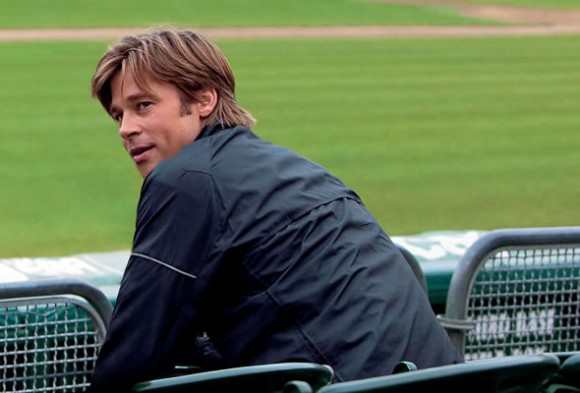
Based on a true story that captivated the nation in 2002, the film stars Brad Pitt as Billy Beane, a cooled-off hotshot who blew a contract with the Mets and isn't exactly making headlines as the Oakland Athletics general manager either. Then Pete Brand (Jonah Hill) comes into the picture, a bespectacled egghead of a young man who believes he can re-invent baseball with a simple plan: shit-can the sentimentality and recruit based on not star power or likability but concrete data. Computational analysis. Objective fact. Not surprisingly, no one, from the commissioners to the sportscasters to Billy's own coach Art Howe (Phillip Seymour Hoffman), is a fan of said approach, and Beane and Brandt are left with the singular task of winning the series, and, by extension, changing the sport.

It's a conventional underdog's tale, that's for sure. But what it isn't is a sports movie. Yes, baseball is a prominent part of the plot, but to call it the movie's main focus is infantile and reductive--the equivalent of calling Nashville a movie about country music. This is a character study before it is anything else, and it rides on the shoulders of its cast. The story of the Athletics 2002 season is bursting at the seams with larger-than-life individuals ready-made for the big screen. You've got Brandt, a Yale grad alternately emboldened and embarrassed by his genius. You've got Howe, a seen-it-all survivor who treats the game like a lover who's broken his heart one too many times. There's Scott Hattenberry (Chris Pratt), an injured player whose recovery and athletic resurrection deserve a movie all their own. We have the old recruiters, who refuse to go gently into that good night, and view "moneyball" with a potent mixture of can't-help-it awe and lion-in-the-winter fury. But front and center, we have Beane, a charismatic catastrophe of a single fortysomething who embodies all that's good and bad about middle age. A drinker, a dreamer, a thrower of tantrums, and a deeply lost soul, he's the kind of character that comes with a little tag saying "Overplay Me!" Pitt knows better, and does his business with a quiet austerity that's at first off-putting but works wonders in the long run. If nothing else, Moneyball marks the final stage in his evolution from Brad the Body Beautiful to Brad the True Blue Actor; here he uses everything he's learned about life, love, and the cinema, to deliver a real knockout of a performance, one that shows off Billy's agreeable charm and commendable commitment to the game, but doesn't do away with the demons festering underneath it all. To paraphrase Hemingway, he has burned the fat off his soul, giving a performance that contains everything it needs and absolutely nothing it doesn't. Look at the movie's raw final scene and take a moment to realize that Pitt's been building up to it all along, not with the "a-ha" gimmickry of a cheap magician, but with the steady, unforced confidence of a ball player who knows he's got a home run in him. It's a career performance, and the other actors match him move for move--Hill reaches new heights by staying grounded, Hoffman breaks your heart and then patches it back together, and damn near every player on the team gets their thirty seconds to shine. Screen Actors Guild, pay attention.

Even if the cast is perfect, the movie isn't. Aaron Sorkin, the toast of the screenwriting community after his monumental Social Network, packs the film with his famed dynamite dialogue, but he also tacks on one of those flabby, multiple-ending finales. Some of the game-time scenes indulge in unfortunate running-man-in-slo-mo cliches, and Brand's game of numbers is often overwhelming and occasionally exasperating. Still, give Team Moneyball props--they've turned a story of facts and figures into an emotionally engaging work of flesh and blood. Here's a mainstream movie that steps up to the plate. Time for the rest of Hollywood to follow suit. B+.

--

Drive

"I'm a fetish filmmaker", Nicholas Windig Refn declared in an interview earlier this year, and indeed, much of Drive is comprised of the director's almost obsessive attention to the little things that turn him on; fast cars, lonely heroes, and explosions of pent-up, impotent brutality. But for all the passion Refn pours into his American debut, it comes off like one of those sky-high-priced cars on display at an auction; sleek and impressive, but also more than a little remote.

There isn't much plot; we've got the Driver (Ryan Gosling), stunt double by day, getaway assistant by night. We've got Irene (Carey Mulligan), the dotty mother he befriends. And we've a couple of crooks (Ron Perlman and Albert Brooks) the Driver gets all mixed up with as he attempts to protect both Irene from the wreckage wrought by her husband-with-a-shady-past (Oscar Isaac). As the plot stipulates, there isn't much to these characters, either. Mulligan furrows her brow alot and cries on command. Perlman does a decent Goodfellas impression. And Gosling just stares. And stares. And stares. I know, I know, by nature, the Driver is a mystery. But if you're gonna play the Enigma Game, you've got to find an actor who can convey everything that the writers leave out. Look at Clint Eastwood's Man with No Name, or, more recently, Uma Thurman's bride. Because these actors specialize in finding hidden layers of meaning in conventional stoicism, their demeanor reflects that of a person, who, through years of hard living, have whittled themselves down to the essentials, carrying with them food and water and clothes and nothing more, not even their old nomenclature. However, while Gosling is more talented than any one human has a right to be, he can't play it straight; he gets by on his idiosyncratic charisma and puppy dog charm, which he maintains in even his grimmest roles (Half-Nelson, anyone?). Stripped of that singular it quality, he's got nothing to do but narrow his eyes and pout. It's like watching James Dean's mumbly, Method-ized work in the final 15 minutes of Giant, but for a full hour and a half.

So, with the skeletal plot and character development, what's left? Style. That's supposedly the picture's Big Draw, and it certainly has a look all its own, mixing Scorsese's Brooklyn immediacy with Bergman-esque European ennui, with a dash of Michael Mann's neon-jungle color schemes thrown in for good measure. It's a helluva movie to look at. Unfortunately, the mise en scene, gorgeous as it is, is at odds with the picture's thematic content; long, contemplative shots of seascapes and eyeballs and downtown LA have no place in a movie where death by fork is a viable possibility. Refn has a true, Cronenbergian gift for orchestrating outbursts of violence that hit so hard they seem to leave viscera splattered all over the cinema seats, but these moments are so awkwardly sandwiched between exasperating moments of shoegazing and deep-dish philosophizing that their power is dulled considerably. Only in the opening car chase does Refn successfully implement his aesthetic experiment.

Experiment. That's the best word to describe Drive, and it's why I don't regret seeing the picture, even if I was immeasurably disappointed. Refn isn't blending pulp and prestige in hopes of maximizing both box office glory and critical hosannas (I don't like that). He's an international man out to break down barriers between cinematic cultures, mix up the melting pots of modern moviemaking and create a heady concoction all his own. It's got a flavor like none other, even if you do want to spit it back out.

I should note that there is one truly great thing about Drive, and his name is Albert Brooks. He internalizes his famed comic exasperation and turns it into something deeper, truer, and scarier--existential fury. His character comes off like the movie itself--bold and brilliant, but destined to fall apart. C.