Sunday, May 1, 2011

Some Kind of A Man


TOUCH OF EVIL
It is a thousand things; a flawed masterpiece, a marvel of analog technical achievement, a tale of impotence both sexual and psychological, an imbalanced but indispensable piece of social commentary , and a mournful howl from a cinematic demi-God dethroned. However, for me at least, one of Touch of Evil's most important characteristics is that it is basically a re-hash of The Third Man, re-done and done correctly.
Both films feature deeply moral, self-righteous, slightly naive heroes who cross paths with publicly patriotic but privately corrupt men (played in both cases by Orson Welles) and as a result have their faith in their country, and by extension the world, shattered. I know, I know, The Third Man has long been considered one of the best films of all time, while Touch of Evil is often dismissed as an smartly directed, enjoyably garish piece of scuzzy drive-in noir. This never-ending love affair with The Third Man remains to me one of the most mysterious aspects of film-critic psychology; here is a film that desperately wants us to feel its existential fever in our bones, but that gives us a villain too cracklingly charismatic to really hate, a hero too bluntly inept to really pity, and a visual style that doesn't assist with the conveyance of mood, but instead replaces mood. It wants to take us into the depths of the human condition without getting its hands dirty; it over-aestheticizes its story and thus de-claws it.
Nine years later, Welles went behind the camera and basically put the same story up on the screen again, and what an improvement it is; Touch of Evil is a grungy, gutsy journey into the heart of darkness, but it's also a fiendishly entertaining potboiler. What makes the movie work is its lack of vanity; the characters are allowed to sweat and spit and smoke and drink, and the border town where they do all these things is presented pitilessly, as a hot, venal hive of sexual confusion and petty grievances. Here, two matinee ideals (Charlton Heston and Welles himself) team up to de-glamorize the kind of movies that made them famous, to strip them of excess idealism and bring the genre picture into the turned-on, pissed-off sixties. Old Hollywood dies here.
-----

The opening shot is perhaps the most famous in movies, so much so that those who've never even seen a Welles picture can identify it. We start off with a quick glimpse of a bomb being placed in a car. The trunk shuts, a clueless couple enters the vehicle, and they start off down this border town's Main Street. As we follow the car, we're introduced to the townspeople, the cops, and our two main characters: Vargas (Heston), a Mexican cop crossing over into the US to honeymoon with his American bride, Susan (Janet Leigh). It is only when the car explodes and Vargas dashes over to the scene of the crime that we realize this entire prologue has been one four-minute unbroken take. In the simplest terms, the picture is about this explosion, its aftermath, Vargas's quest to solve it, and the devastating consequences of his curiosity. Quinlan, a local celebrity cop (Welles) is put on the case; his unsound methods send Vargas searching for departmental corruption, much to the chagrin of Quinlan's loyal Sergeant Menzies (Joseph Calleia). Meanwhile, Susan checks into the local motel, and is subjected to a real night from hell, culminating in a drug-aided assault that ties all the divergent subplots together and sends the picture racing toward its increasingly inevitable conclusion.
A pulpy plot, yes but, to borrow a phrase from Pauline Kael, "kitsch redeemed" was Welles' speciality. After all, the downfall of Charlie Kane was melodrama to the bone until Welles saw the Shakespearean sadness at its heart; The Magnificent Ambersons would be a stew of cliche had he not spiced it up with operatic grandeur. And Touch of Evil would be a long-discarded hunk of scratched celluloid were it not for Welles's bleak worldview, as well as his encyclopedic knowledge of and general disregard for genre conventions.
This is noir informed by noir, with characters in a studio flick make use their experience viewing similar studio flicks. Their recognition of cinematic stereotypes isn't the driving force behind their actions-it's just one of the countless factors that determine their attitudes and actions-racial prejudices, unfounded phobias, past experiences, etc, etc. Take for example Susan's run-in with local kingpin Grandi (Arif Tamarik) and his lackeys. They don't strike out at the newlywed, though that comes soon enough. They simply circle her like an incensed snake, dropping little insults and vague threats. She'll have none of it.
"You know what's wrong with you?", she retorts, "You've seen too many gangster movies."
Less than a decade earlier, a line like this would've been unthinkable. But the deluge of crime and noir pictures released in the late 40's and early 50's (High Sierra, White Heat, Key Largo) meant that such trash talk was now common knowledge. These men can't intimidate Susan--she's seen it all on the big screen. By referencing pre-existing knowledge of genre, and thus indirectly alluding to individual films, Touch of Evil paved the way for the meta-movie--pictures like Pulp Fiction that use cinematic cross-referencing to deepen their characters, or the Scream series (side note: since the new one is legally titled Scre4m, do I call it "Scream 4" or "Scree-four-MMMM"?), where literally the entire plot is driven by the plots of previous horror movies.
It's not just the characters movie know-how that makes this one interesting-it's Welles's too. There's a standard-issue cop drama scene where a potential perp is interrogated, and, when things don't go well, he gets the bloody bejesus beaten out of him by a livid lawman. This scene has been done to death, portrayed in every way, shape, and form allowed by the ratings system. Welles', having made as well as seen his share of thrillers, knows this, and thus shows us what we haven't scene-the reactions of the other people in the room. We merely hear the noises from the thrashing (which, incidentally, allows us to visualize far more with our rampant imaginations than Hays Code Hollywood would've ever flat-out shown), and shift our gaze to men who have seen this hundred times before, but still flinch a little as if it were their first day on the job. The words are the same, but the illustrations have changed.
---
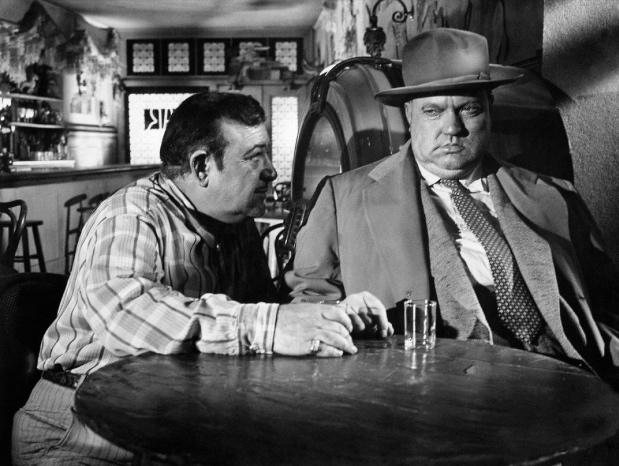

One word comes to mind when I think of this film; rot. Even fifty some-odd years later, I can think of few movies as explicit and effective in their portrayal of blight and corruption. Everything in this movie is decaying; the city streets, the country roads, the bars and alleys and windows and walls. The abstract, too--Susan's innocence, Vargas's naivete, and, hell even moral decay itself decays, as the local gangsters shed all traces of the honor-among-thieves philosophy and resort to half-baked drug runs and itchy-trigger-finger revenge schemes.
But no one is falling apart quite like Hank Quinlan. The local emblem of justice and vigilance, he so fears Vargas's campaign against him that his efforts to thwart it turn him into the very kind of monster he once prided himself on bringing to justice. By the end of the film, he's a fallen idol-but, then again, by this point in his career, so was the actor who played him. Welles was weighed down by his constant battles with his women, his studio, and his audience (his adaptation of Camus' The Stranger so infuriated some moviegoers that they hung him in effigy after they saw the picture). His endless struggles to fulfill his often difficult vision had stripped him of his pretty-boy looks, leaving him a moribund mass of flesh and bone and broken dreams. Perhaps that's what drove him to turn a piece of pulp fiction into a scathing meditation on the dissolution of all things bright and beautiful. It is Welles' understanding of Quinlan that makes his performance resonate, and lifts the movie from good to great. Watch the scene where a cheap hood tricks him into breaking his teetotal streak. As he contemplates the empty glass in front of him, his stubble-choked jaw sinks, his mouth twitches, his eyes are filled with years of dammed-up misery and self-loathing--this is powerful stuff, stuff that haunts your dreams. Welles' sadness becomes Quinlan's sadness becomes our sadness--and, in a scene all the more heartbreaking because it allows him a brief moment of satisfaction, his happiness becomes our happiness as he stands by an old pianola and reminisces with and old flame (Marlene Dietrich, of all people). Hank Quinlan is one of the most endlessly fascinating characters in the movies.

This leads me to the film's one major flaw; while Welles' clearly made it because he was drawn to the Quinlan character, the novel open which it is based, Badge of Evil, puts Heston's Vargas at the center of the action. Every character in the piece is more interesting than Vargas. To wit; Susan is an unusually tough broad. Grandi is evil but almost comically inept in the ways he implements his evil plans--until at last one is successful, with lethal results. And Menzies, while at first just a typical cop-with-a-conscience, ultimately becomes up the picture's only paragon of goodness and redemptive possibility, an almost Christ-like figure. How can a typical tough-guy detective stack up against that roster?! Nonetheless, I don't doubt Heston and Welles could've come up with something. But Welles' the actor was so busy losing himself in a part that was clearly an object of obsession that he didn't have much energy to devote to coaching his lead. As such, we're fully conscious of the difference between Vargas and the more dynamic supporting characters everytime Heston comes onscreen. He was a good actor, but not good enough to compensate for the fact that there's a great big black hole where a 3-D character should've been. Forget the fact that he doesn't look Hispanic--there are times in this one where he doesn't even look human.
But, as with works by everyone from John Milton to Peter Jackson, this is a creation of such unwieldy ambition that we forgive the flawed whole because so many of the parts are staggeringly successful. There is a weak lead performance. But there is solid ensemble work. There is a setting that enters the geography of our psyche as few movie towns really do. There is technical mastery that manifests itself in the smaller moments as well as the big action setpieces-that final chase, with Vargas trapped in the middle of an out-of-control oil derrick, is a doozy. There is a score by Henry Mancini that is one of my all-time favorites. There is a healthy dose of gallows humour. There are deep moral inquiries made without pretension or excessive deep-dish philosophizing. And, of course, there is Hank Quinlan. Marlene Dietrich speaks the final line, which serves as both an insult and a compliment to him; "He was some kind of a man." Yes, and because of him, this is some kind of a movie.


Welles in his youth.
Nota bene: Whether or not this is exactly what Welles' wanted us to see, we'll never know-Hollywood butchered his original cut. Luckily, he left a lengthy pamphlet detailing how one would go about reconstructing his damaged masterpiece, and, with an army of film restorers, critic Jonathan Rosenbaum spent years and years making sure his instruction were followed almost to the letter. Thus, a filmic phoenix, risen from the ashes. And they say critics are good for nothing!

Saturday, April 23, 2011

The Parade's Passing By!


Like I said, today's a special day for me--Barbra Streisand's 69th birthday. I will be physically taping my ass to the couch and watching Yentl on repeat, reciting all of Mandy Patinkin's lines in an attempt to pretend that Barbra is wooing me and not him. I mean what?
People are very strange these days.
Anywho, I'm sure you're expecting some sort of massive essay that sums up exactly why I love La Streisand. But I'll tell you a secret. I plan on writing said essay someday, but I'm saving it for when I've got a real downer on my hands-a car wreck, a family emergency, a big ol' argument, etc etc, because I know writing it will make me so damn giddy that I'll stand on the nearest piece of furniture and belt out "Happy Days Are Here Again". In the meantime, I must do something to honor the woman who is my wife...I mean life. So, here are THE TEN BEST BARBRA STREISAND SONGS EVER. Listen to these and you'll begin to understand what makes her the single greatest vocalist of our time. If you love me, you'll check out at least one, fool. Listen here. Then read about what makes 'em great!

10. Bewitched, Bothered, and Bewildered (Judy Garland Show)-In a time when the epitome of pop music romanticism is Bruno Mars, Streisand is more important than ever because she represents the last Traditional Songbird-she opened for Benny Goodman, crooned with Louis Armstrong, and, of course, spent a precious thirty minutes on The Judy Garland Show. A walking repository of pop music history, Streisand almost singlehandedly carried the American standard into the rock era. To watch her alone in the spotlight in the midst of the British Invasion, delivering a limpid, full-bodied rendition of one of the world's greatest showtunes, is to realize that, were it not for Barbra, we might have already forgotten Rodgers and Hammerstein, Arlen and Berlin, Merrill and Styne.

9. Don't Rain On My Parade-Of all Streisand's hits, this is the one that comes the closest to being a part of our common cultural lexicon-those ten or eleven songs that are so well-known they make up a common frame of reference for every civilized human on the planet. As such, the thing's been covered hundreds of times, but, even moreso than with her other oft-redone recordings, Babs's rendition is the only one that counts. I mean, c'mon-Jule Styne literally wrote the song for her, retooling his entire Funny Girl score once Barbra came aboard so as to capitalize on that voice. It's a rather strange piece if you think about it-the tempo lurches all over the place, strange words receive rhythmic emphasis, and it's far and above the wordiest entry in the Broadway Belter's Handbook. But Barbra makes it work--listen to the way her Brooklynese diction turns "putter" and "butter" into full on verbal assaults, the teasing, almost sensual bend she puts on the first "I march my band out", and, of course, the sheer intensity with which she builds to that final phrase, letting that last "PARAAAAAADE" continue even after the music stops, just to show who's boss. Lea Michele, have a seat please. Watch how this song is really done.

8. How Does the Wine Taste?-Barbra Streisand's wanted all her life-wanted a glamorous appearance (her stepfather used to punish her for "being too ugly"), wanted approval (her mother belittled her singing abilities), wanted true romance (she didn't fall in love until her mid-50s). Babs knows yearning as well as anybody alive, its that "I want-I need-I must" urgency that electrifies her vocal delivery, giving shape to her words and life to even the simplest melody. At first glance, this cut from her People album is a simple, almost charming reflection on the mysteries of the adult world; but as Streisand builds, her voice crescendoing along with the reeds, it becomes a towering anthem of sexual curiosity, adolescent angst, and human frailty. By the time her voice breaks on that final phrase, her wants have become ours, and we share in her beautiful but broken world. All in two and a half minutes. I need to change my pants now.

7. I Believe in Love-The early 70s were a tough time for Barbra-for the first and last time in her career, she deep-sixed standards singing and released a barrage of rock-cover albums in an attempt to appeal to the Woodstock generation. Listening to her too-low, spacey arrangement of "With A Little Help from My Friends", or her strained, insipid take on "Life On Mars". Only once did Streisand successfully bridge her rock-singer dreams with her cabaret-classy talents; in this disco piece, written to order for her A Star is Born remake, the beat is so emphatic that she has no time for the excessive vocal improvisations that mar all of her other rock efforts, and she takes full advantage of the lyric's almost theatrical build, something you wouldn't see in any of the songs from her What About Today? or Barbra Joan Streisand albums. When she lets that final riff rip, with the band tearing it up behind her and her face backlit to perfection, Streisand is, for a moment anyway, the sexy pop artist she always dreamed of being.

6. A Piece of Sky-What is there to say? One of the greatest Streisand hallmarks is the Really Long Note. There's a Really Long Note Song on just about every album she's ever done, in every TV special she's ever headlined. This is the king of 'em all. Composed as the Yentl finale, but doubling as an ode to Streisand's father (who died when she was still a baby), this recording contains some of her most emotional singing-when she sings "There will always be/more to question yet more to believe", her luxuriant decrescendo gives the lyric a poignancy the songwriter's could never have anticipated. And then there's that final note, clear as bell, high as the sky, held for 20 seconds. But Barbra isn't just showing off. It's not how long she holds the note, it's how she sings it as an affirmation, how it speaks of total belief, inner strength, of overcoming life's hurdles. This is what great singing is all about.

5. When the Sun Comes Out-Streisand's voice, with its contrast between purring vibrato and piercing belt, was meant for the torch song, and she's never sounded better than on this Arlen-penned heartbreak ballad. She reels you in with that delicate opening, giving each word of the title phrase a precise, gleaming spin. Then, as the lyric compares loves to bad weather ("Just when everything seems bright and sunny/suddenly the cyclone came"), she grows in volume and intensity, and by the time she's shouting "Let it rain, let it pour!", her emotions are so intense they border on parody. Top it off with that whopper of a final note, with Streisand sliding up the scale to match the white-hot work of the brass musicians. Damn. Uh.

4. Avinu Malkeinu-In an era where a new-agey belief system is almost a requirement for celebrities, Streisand has stuck to her religious guns, always an open promoter of Jewish ideals and laws. It is this steadfast belief that shines through in her flawless arrangement of one of the most beautiful Jewish hymns. Sung in the days leading up to the Jewish New Year, "Avinu Malkeinu" asks God to help us renew ourselves as we renew the Hebrew calendar. Singing with flawless diction and Hebrew pronunciation (what CAN'T she do?!), and backed by a massive choir, Streisand forgoes all vocal ornamentation and eschews conventional belting, turning in a simple, direct reading that allows us to focus on the beauty of the text, and of her ageless voice, one that time has only burnished.


3. Somewhere (2000 "Timeless" Version)-Streisand's Timeless tour was a failed and unnecessary attempt to pair the the Great Diva with Vegas-style pyrotechnics and multimedia integration, but it did have one shining moment-a re-tooled rendition of Streisand's 1985 hit single "Somewhere". Freed from its electro-pop chains and garnished with the sound of a full orchestra, the song can finally soar, and Streisand with it. As she duets with Lauren Frost (a 13-year-old belter meant to represent the Ghost of Barbra Past) on the final chorus, her top notes still readily available at age 59, we get the indelible and moving impression of a great career come full circle.

2. Emily-The sheer purity of Babs's singing voice is her greatest asset, but her phrasing is a close second. This old movie theme, re-written especially for Barbra, features the name "Emily" sung at least twenty times-hell, it's basically the entire chorus. But every time she sings it, its different-breathier or beltier, longer or shorter, ecstatic or filled with melancholy. This is not just talent. This is genius.

1. I Had Myself A True Love-The concept is simple-a scorned lover sitting on the porch, waiting for her man to come home. From this, Streisand creates an entire world. She starts off clipped, crisp, behind the beat, almost conversational. As the full orchestra comes in, she relaxes into the piquant melody, making the word "time" a self-contained gem of glimmering legato. Then, the bridge-the orchestra pulses, alive with a Gershwin-esque bluesy throb--Barbra builds. Barbra belts. It all builds to "No!!! That ain't the way that it used to be!", a phrase she socks over with all the fiery abandon of Mahalia or Aretha. Then the orchestra stops. That voice. In the clear. She yanks all of the sound into the back of her throat, delivering the next few lines in a raspy, wounded whisper we've never heard before. Finally, she reaches the last word-"love." The thing she sings about. The thing she conveys to us, the listener. She starts it small, builds, builds, builds, and for a few seconds, she is in full cry...that is, until she stops a few beats ahead of the orchestra, leaving us on the edge of our seats. Thrilling-there's no other word for it. The best recording of an American standard. Ever.

HAPPY BIRTHDAY, MY LOVE!$$

Also;
I'm pleased to welcome bread back in my life. Passover 2011: No Regrets.

Friday, April 22, 2011

Passover by the Numbers


I'm writing this post because, in the last few weeks, I've been invigorated and moved by my friends interest in my religion. Also, because the word "Jew" is in my blog title, and the words "Non-stop Film Analysis" are not. Let me know how you like it...maybe I'll do more! Also, expect another post tomorrow....sorry to bother you so much this week, reader, but there are two big events in my life within the next few days. The first one, of course, is PASSOVER....


5 Mucho Importanto Facts el Passover (Viva la Taquito ay ay ay)

1. Passover (Pesach in Hebrew), lasts a week, from sunset on the first day to sunset on the last.

2. The holiday's purpose is to celebrate the Jews' victories over our oppressors, in Ancient Egypt and around the world, to mourn the lives lost in our struggle for freedom, and to pray for those among us who remain enslaved, spiritually or physically.

3. In keeping with the liberation motif, adults are encouraged to study the story of Moses and the Exodus in its Biblical form; younger children often read Haggadahs, simplified, illustrated adaptations of the same story. Like all children's books, they tend to play loose with history. Case in point-our family Haggadah features a picture of Moses walking his dog, something I'm pretty sure got the shaft in the original Old Testament. Believe it or not, the making of these things is a full-blown business; even non-literary companies like Maxwell House put them out.

4. Jews spend at least one of the seven nights at a seder. Seders consist of short, self-led prayer services, as well as the consumption of foods unique to the Passover season. These include karpas (a leafy vegetable dipped in salt, to mimic the tears of the enslaved), maror sandwiches (a combination of horseradish and blended apple-cinnamon, meant to convey the bittersweet nature of the human experience), and four sips of kosher wine, which some of the older members of our seder tend to misread as "four cups", with interesting results.

5. And of course, the one universally known Passover fact: We Don't Eat Bread, which sounds easy enough, but:

10 Things That Have Some Sort of Bread In, Around, On, Beneath, or Inside Them/Are Just Plain Bread:
1. Sandwiches of all kinds.
2. Cookies.
3. Doughnuts.
4. Cake. The dessert, not the modestly successful, critically renowned indie band of some note.
5. Toast.
6. Pancakes. This one hurts.
7. Pretzels.
8. Burgers, although whether the Big Mac bun is made of actual dough or just body parts is up for debate.
9. Brownie$$$$$$
10. Bread.

3 Reasons Why, To Me At Least, The Whole Bread Thing Makes Sense:

1. When Moses and co were on the lam from Pharaoh and friends, they didn't have time to bake anything, and simply ate matzot, flat pieces of unrisen bread that taste like salted air. After eating these for a week, you begin to appreciate how much time and effort is lavished on every piece of food you put in and around your mouth. The creation of good cuisine is some kind of small miracle.

2. It creates a strange but palpable sort of fellowship between Jews from all walks of life. For one week, we are all faced with a series of common problems; how to explain to our co-worker why we can't accept that freshly baked pie; how to ignore the latest Quizno's creation beckoning us from a far-off billboard; how to politely decline every piece of birthday cake that comes our way for seven days, while wanting it all the same. Through these rituals, we achieve religious unity in an era where belief is too often a business, or, more accurately, a thousand different businesses jockeying for the same clients.

3. Here's where our culture and that of Christianity dovetail; we've got Pesach and Lent going on all at once. Both holidays commemorate a Biblical event, and both stress self-sacrifice in order to truly understand what's essential in this world and what isn't. To realize that we can in fact live without what is considered the most basic of food groups shifts our perspective considerably. We can refuse bread and do just fine...couldn't we refuse that $3000 Gucci purse? That art-deco furniture that costs more than your average duplex? Those rims for our low riders (guilty there.) I think these small sacrifices are something everyone should attempt sometime, religious or not, because during this time of self-discipline and reflection, all the luxuries masquerading as necessities are unmasked; that's the point. Unless you choose...

The 1 Wrong Way to Go About the Whole Bread Thing:
1. "I ate a Pop Tart (TM)*. That's not TECHNICALLY bread, so I'm good! Tee-hee." The point is not to set some impossible goal (NOTHING WITH FLOUR IN IT, AT ALL! THAT COUNTS AS BREAD!) and then try to get around it. The point is to make some reasonable concessions, and see where they lead you mentally, spiritually, yada yada. Cutting out sandwiches and cookies and pancakes, pretty much my lifeblood, is enough to get me thinking; I tend to let breaded products (chicken fingers, cheesecake) slide. As Fleetwood Mac said, you can go your own way...as long as it ain't the easy way out.

*The Pop Tart corporation paid $100000 for the above product placement; I will be using that money to buy Adele.*

*By Adele, I mean the actual singer, not her new album.

In conclusion, the Jewish Film Nerd looked at Passover and found it good. I'm picky about my Jewish holidays-if I don't like them, I don't even try to get into the spirit (a day celebrating trees and botany? I took a 1st grade field trip to the Arboretum, mmkay?). I always attempt to treat Passover somewhat reverently, and it is in my opinion one of the more meaningful Jewish holidays. Also, fun fact; statistics show that more and more Christians are holding seders of their own, in an attempt to experience our culture. Now you know how we feel at your Christmas parties, guys.

Chag Sameach! (A joyous festival to all!)

Sunday, April 10, 2011

The Next Four Years

I don't do personal posts often; after all, wouldn't you rather read about Greta Garbo's secret life instead of what I had for breakfast this morning? But I today I made a decision that's worth spilling some metaphorical ink about. After two years, six family trips, and thousands upon thousands of milquetoast hotel breakfasts, I have decided to attend Trinity University for my collegiate education. As I've no doubt that the Trinity experience (TM, bitches) will change me as a critic, a student, and a member of the human race, I feel justified in blabbing on about myself for a bit, and in taking some time to explain what makes Trinz (my patented abbreviation) right for me, what made some of the biggest/most prestigious schools in the country wrong, and what this whole journey has taught me. I could try to make a big, essay-type deal out of this, but the truth is, I don't have long-I'm off to get shitfaced and celebrate! LOLOLOLOLOLOLOLOL JKJKJKJK. But really, I does have a celebratory luncheon some of my favorite Jews in just about an hour. So, real quick-like...
---

Basics: San Antonio, Texas. 2, 487 undergrads. The Tiger is the official mascot. Founded in 1869. Not religiously affiliated, despite the name.

Why it bested NYU and Chapman in Le College Hunt:
With NYU, the answer is simple; the tuition, while not absolutely unattainable, would've bound me to a student loan for all eternity, and all but erased the possibility of graduate study. Plus, letting someone who cried himself to sleep at a Jew-camp three hours from home loose in the world's craziest city as a college freshmen is just not a quality idea. As for Chapman, while I was impressed with their burgeoning film program, there was something incredibly homogenized about campus life; everything seemed a little too manicured, too perfect, too airbrushed. The university seemed to be more concerned with success than anything else; I saw too many men in suits gesturing to charts outlining networking opportunities and work study, and not enough current students gushing about personal growth or newly acquired knowledge. I don't mean to knock Chapman-it's earned the reputation it has for a reason. But, as the pamphlets say, its a "university on the move", and I think I'd get trampled. Plus, three people to a dorm room---what is this, a center for ants?!

Why I LOVE it:
In a word; alive. Trinity is the antithesis of every stuffy stereotype of college life. For one thing, there's the city, which is so much more than one giant Alamo museum. It's in Texas, so the occasional cowboy hat or Republican bumper sticker sighting is inevitable, but alot of the funky juice that powers Austin leaks over into San Antonio; here's a city with three indie movie theatres, a cabaret, a Broadway-themed restaurant, and (my favorite) a combination burger-joint-laundromat-car-wash with an all-female house band, Ellen and the Degenerates. The effulgent quirkiness pops up in the students as well; they affectionately refer to Coates Hall as "Jackets", hold drug-free raves in the library, and pair economics majors with guitar performance minors. In short; these are people like me. People I can gush about cinema in front of. People I can do my attractive mating dances for. People who I can live with, literally and figuratively, for the next few years. I haven't even mentioned the faculty members I have met, impassioned, accessible, and above and beyond qualified for their respective jobs. I haven't gotten to the campus, in all its red-bricked glory. And I suppose I should bring up the dorms, which are frequently proclaimed the best in the nation. Yes, the triple digit temperatures are an issue; but a few extra bottles of SPF are a small price to pay for what I fully expect to be a phenomenal, formative college education.

What I've learned:
Visit the campus. I can't say that enough. I hated the idea of San Antonio, but the reality turned out to be an entirely different bag of chips. Talk to as many students as possible, and with as few adults around as possible; these are the guys who can tell you what it's really like. Look at student publications to gauge the rhetorical ability of the students, as well as their perception of their school. Get meetings with department heads; grill them. It's their job, whether they like it or not. Demand to eat in the cafeteria, even if you have to take hostages. Ask: What's one thing you don't like? Your favorite thing? How do you find the city? The dorm experiences? Trouble with roommates? Partying? Easy to get around? When you think you've asked too many questions, throw out two or three more for good measure. Stalk Facebook pages. YouTube performances, news updates, local columns. Most important is this; if your gut is telling you something...listen.

While we're at it, a preview: Within the next week or so, I'll be posting a HUGE-ASS ESSAY I've been working for a few weeks now. It's some of my best, methinks. Get excited.

Oh, and one more thing:
Well....how do I say this eloquently? I tend to find women of the collegiate variety exceedingly attractive. Ooo gurl. Uh.

Saturday, March 19, 2011

Green Destiny Takes A Hand


Crouching Tiger, Hidden Dragon
I was once part of a play where the entire second act revolved around a murder. Problem was, every night, like clockwork, the murderer's gun would jam. Mind you, we loosed whole rounds in approximately 525, 600 other scenes throughout the show, but the one time it counted, the bullet always missed its cue. After a while, we were so discouraged we just about wound up not loading the damn thing at all-it seemed there was a better chance that it would produce a bullet out of thin air than actually expunge the one we inserted. That's when we got the talk.
"Whether the gun goes off or not is irrelevant", our director said. "Ideally, if you immerse yourself in the part you're playing and sell this piece, really sell it, you could yell 'BANG!', drag the body offstage, and move right the play right along without a single unwarranted giggle."
The miracle of Crouching Tiger, Hidden Dragon is that, while the story technically hinges on a series of battles , you could surgically remove all the fisticuffs, replace them with verbal altercations, and still wind up with a compulsively watchable work of startling depth and thematic fecundity. It's just that great.

Li Mu Bai (Chow Yun-Fat) and Yu Shu Lien (Michelle Yeoh). Legendary warriors. Best of friends. Each nursing a secret longing for the other, each all at once too inflated with and constricted by pride to act on their ever-burgeoning emotions. Each increasingly weighted down by the demands of their lifestyle, until one day Li Mu Bai arrives at Shu Lien's dwelling with an announcement; he's giving up the life of the swordsman, a path that has brought him "as much trouble as glory." As an external gesture of his renouncement, he asks Shu Lien to take his famed sword, the Green Destiny, and deliver it to his friend Sir Te (Sihung Lung). But mere hours after Te first holds the weapon in his hands, a masked bandit snatches it right out from under his nose. As Shu Lien and Mu Bai pursue the thief into the heart of fractious 19th-century Peking, they take Jen (Zhang Ziyi), a rebellious young aristocrat, under their wing, join forces with a renegade police inspector and his daughter (De Ming Wang, Li Li), and cross swords with Jade Fox (Chang Pei-Pei), Mu Bai's mortal enemy and the killer of his master. But perhaps the most insurmountable enemy of all is the volatile passion that threatens to pound a thousand chinks in their carefully constructed armor of honor and restraint...
And your eyes are glazing over. You don't like kung fu movies, do you, Jimmy? Well, at the time of this one's initial release, I was a skeptic. My experience with martial arts cinema was limited to the first Rush Hour picture, which, Oscar success and frenzied critical acclaim aside, was perhaps not the best introduction to the genre. I wasn't exactly clamoring for more martial arts at the time, and so, when my papa offered to take me to the new Ang Lee film, I opted for a second viewing of 102 Dalmatians instead. After Glenn Close dropped her last one-liner and the credits cycled through, I went out to the lobby to meet up with my dad, who had just finished his first viewing ofCrouching Tiger. When I ask him what he thought of the movie, I noticed something very strange; there were tears in his eyes.
"Did somebody die?", I asked, as only a 2nd grader could.
"In the movie", he responded.
"But it's just a movie, right Dad?"
"Yes, but....yes."
That "but" made all the difference. For someone who then considered Tarzan the most absorbing experience of their moviegoing career, the idea that something projected on the silver screen could cause the same tears that welled up when I skinned my knee or lost my homework was a decidedly alien one. There were different kinds of tears, I'd soon learn. Also, different kinds of movies.
---
I saw Crouching Tiger, Hidden Dragon a week later, the day before Christmas Eve, in a nearly empty, rarely cleaned theater across from the H-E-B market in Waco, Texas. I'll never forget the location, just like I'll never forget what took place there.

Twenty minutes into the picture, the first fight occurs; Shu Lien vs. the thief. By the light of the moon, Shu Lien chases her mark through down streets, around corners, down crowded alleyways and onto slanted rooftops, until finally, they land in front of the governor's palace.
"Give me the sword, and I'll let you go."
No response. The thief strikes a blow, Shu Lien counters. Tan Dun's percussive score kicks into overdrive, and so does the skirmish. Shu Lien lobs bundles, dust, bits of brick, anything she can get her hands on. The thief easily outpaces its rival without even employing the stolen sword. Clearly outmatched physically, Shu Lien places all her bets on a triumph of intellect, trapping the thief in a cramped corner. Then, a deluge of darts, fired directly at her neck; whoever this thief is, they aren't working alone. The thief breaks free of Shu Lien's grip, and, in a single fluid motion that puts the Wachowski Brothers to shame, scales the wall and soars over the palace roof into the dead of night.
When the masked bandit embarked on that first leap of faith, my imagination leapt up with her, and a lifelong love of the movies was born.
It is entirely appropriate that the most frequently discussed characteristic of Crouching Tiger is the vivifying disdain it shows for our pre-established laws of gravity; this is perhaps the most obvious example of the artistic autonomy that sets this apart from most other genre pictures and imbues it with a great deal more importance than most critics or casual filmgoers generally ascribe to it. This is one of the more daring films of the last decade, but its rebellion is quiet; like Written on the Wind, Cat On A Hot Tin Roof, or even The Pajama Game (it wasn't every day two unmarried folks slept together in the 50's), it disassembles the barricades of genre convention so stealthily that it's only after a second or third viewing we noticed the paradigms have fallen. Actually, the picture doesn't so much wipe out the action-movie blueprint so much as alter the architecture a bit.
---
"Why do you cry?" These four words, spoken by The Terminator to John Connor in Terminator 2: Judgement Day, provided one of the great false hopes of movie history. Judgement Day was an absolute sensation when it hit theaters in 1991. The groundbreaking special effects and visionary production design were lauded, but what really made the movie stick-and indeed, it still "sticks" to this day-is the way it mixes gung-ho shootouts with the kind of unforced sensitivity you'd expect in an awards-season pieces. There was hope that Cameron's tour de force would usher in an age where CGI techniques and time-tested analog tricks could be used in service of a damn good story, not just a quickie fix for action junkies.
But the hope proved an empty one, for the ascension of ripped, raging robo-warriors like Jean-Claude Van Damme and Steven Seagal drowned out all remaining strains of Cameron's popcorn poignancy with cacophonous mayhem and zero technique, excluding physical prowess. Films like Under Siege and The Quest played like instructional workout videos, albeit with gun-toting body guards instead of weight machines. It was an era of obsessive masculinity, one where the attention afforded to the minutiae of every explosion and roundhouse kick left emotion out in the cold. How else to explain the success of Keanu Reeves?

"I didn't feel the bliss of enlightenment. Instead... I was surrounded by an endless sorrow." 2000. Li Mu Bai utters this sentence, and swiftly turns the tables on a decade of mindless, often badly choreographed and even worthless action cinema. It's fifteen minutes into this kung-fu film, and we've spent almost all of that time sitting with Shu Lien and Mu Bai at a table, listening to the ladder espouse his deep discomfort with the way of the warrior. This film will be taking its time, the scene tells us. The story is not serving the action...the action is serving the story.
What other martial arts movie uses a civil tea party to uncloak the diseased social strata of its setting? When was the last time an all-out fistfight was followed by an almost Bergman-esque mirror shot of two women preparing for bed? What Jet Li or Sonny Chu movie spends its last 15 or so minutes in a disconsolate state of deep-seated regret? If audiences hadn't responded so strongly to such a blatantly unconventional genre film, Hollywood wouldn't likely have greenlit so many of the big-budget smashes that define the last decade; with Crouching Tiger, there would be noMaster and Commander, The Dark Knight, Kingdom of Heaven, Casino Royale, or maybe even Munich. Emotionally potent action films currently in production at the time of Crouching Tiger's release (The Lord of the Rings trilogy, AIand From Hell to a lesser degree) got a significant promotional push once studio suits noted the public's appetite for this type of fare. Hell, this one's influence was international; similar and often equally impressive releases likeBrotherhood of the Wolf and Hero were imported from around the world. Crouching Tiger made it okay for mythic heroes to shed both blood and tears, restored equilibrium to the thinking-man's action movie, and left its mark on mainstream fare for years to come.
---
It is also interesting to note the globality of this picture, both behind and in front of the camera. At the helm is Ang Lee, who frequently cites The Virgin Spring as a major influence but also notes that he is fueled by "novels of derring-do I read instead of doing my homework." It is this interplay between prestige and penny dreadfuls, between his hometown of China and his long-loved New York, between Western highbrow and Eastern lowbrow, that make Lee's work so interesting to watch, and also, I think, mark him as one of our greatest living directors.

He takes elements of camp and approaches them with the respect due eternal art; in The Ice Storm, he takes a feverishly sexual, overtly theatrical story worthy of Douglas Sirk, then turns down the volume and works from a notably restrained visual palette, effectively putting the focus on the characters instead of the absurdity of their circumstances.
In Brokeback Mountain, he starts with a tale innately bound to American politics, then makes his story universal by placing an inordinate amount of trust in silence, in what is unspoken, in the eyes of his actors-all distinctive traits of Asian filmmakers like Ozu and Mizogochi.
And with Crouching Tiger, in addition to paying homage to great studio directors like David Lean and Michael Curtiz (that last scene between Shu Lien and Mu Bai calls to mind Casablanca, no?) he lifts the traditional Western characteristics of individualism and rebellion and carefully, cannily applies them to a decidedly Eastern tale of sacrifice and chastity. Indeed, the trifecta of Jen, Shu Lien, and Mu Bai could almost be seen as a direct representation of this culture clash; Jen stumbles as she casts off her aristocratic duties with the brazen heedlessness of a Western youth, while Shu Lien and Mu Bai collapse under their devotion to theirs. Two extremes. Lee seems to be telling us that the key to harmony lies somewhere in between.
---
All these qualities-the pictures' bravery, its technical accomplishment, its astute cultural commentary-make it interesting. But what makes it a masterpiece, and one of my favorite films of all time, is simply what's on the surface. Every scene throbs with the elemental, electric power of great cinema. Shu Lien's first ride into bustling Peking, the aforementioned rooftop skirmish, the revelation of the bandit, the 20-minute desert flashback, Mu Bai and Jen's chase atop swaying bamboo trees, and the final, devastating pair of confrontations between two sets of doomed lovers-I list these indelible moments as an incantation against all that is false in modern cinema, all that is shoddy and opportunistic, all that defiles the moving image for a quick buck. "It's a feeling akin to seeing Peter Pan fly for the first time or watching the first light-saber duel in Star Wars", says critic Judith Egerton of seeing this movie for the first time, and she's not being hyperbolic in the least. Crouching Tiger has allowed so many to believe in the power of movies again, and it helped me to believe in them for the very first time.